
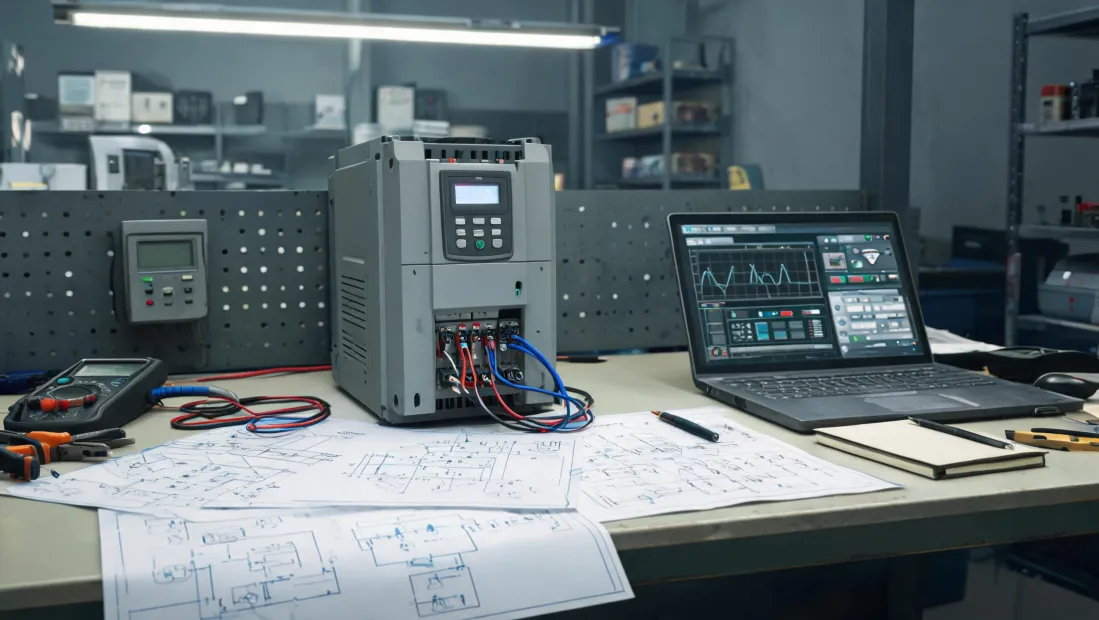
When I took over purchasing in 2020, I thought I had it figured out: research, compare, verify, buy. That system carried me through office supplies, laptops, and furniture without incident. It did not prepare me for the morning our maintenance lead walked into my office with a requisition for Yaskawa VFDs and a deadline that made my stomach drop.
Fourteen units, total: six V1000 series drives for a conveyor line retrofit, eight smaller Yaskawa VFD drives for pump motors, plus a batch of timers for a control panel rebuild. Six weeks to delivery. The maintenance lead had prepared a spec sheet—part numbers, voltage ratings, enclosure types, all the things I'd normally need. I remember thinking: this is straightforward. I've bought equipment before. How hard can it be?
How hard, indeed.
The Price Range That Should Have Told Me Something
Here's the thing about buying industrial components: the price spread is ridiculous. I ran my usual search and found Yaskawa VFD drives listed at prices ranging from roughly 40% below our regular distributor's quote to 20% above it. Same model numbers. Same claimed specifications. Not the same anything else.
The cheapest option came from a website that looked fine. Clean layout, easy contact form, "wholesale pricing available" for timers and drives alike. No phone number, but who calls? I submitted a quote request. They responded within 24 hours with numbers that would have saved us around $4,000 on the full order. I was ready to sign off. Finance would've been thrilled.
Then I asked a few questions. Small ones, I thought. Could they share the full V1000 technical manual—not the quick reference, the complete manual—so our electricians could verify wiring diagrams and derating curves? Were the units factory-new, or renewed, or grey-market imports? Would the manufacturer warranty apply?
Two days of silence. Then a one-line reply: "We will check with our warehouse. Will update soon." Another week. Nothing.
(Why did it take a full week to reach the obvious conclusion? Because I wanted the deal to be real. That's the part I don't like to admit. The 40%-discounted Yaskawa VFD was the story I wanted to tell finance. The reality came with documentation attached.)
Meanwhile, the established VFD supplier—the one who'd quoted 40% higher—had already sent the full technical documentation without being asked. They confirmed the units were factory-new with a Yaskawa manufacturer warranty. They asked about the installation environment: dust exposure? washdowns? ambient temperature? I hadn't thought to check any of those. They also flagged something I'd never have caught: one of the specified V1000 models was nearing end-of-life, and they suggested the current replacement part number. That single note saved us from buying drives that would be unsupported two years into a five-year project.
Seeing those two options side by side made me realize something I still remember clearly: a vendor sells you a box. A supplier makes sure the box works for what you actually need. I'd heard that distinction before. I never understood it as clearly as I did that week.
The Timer Order That Backfired
And yet. I still placed a small order with the cheap site.
Just the timers. Timer wholesale quantities at 30% below market. A low-stakes line item, I told myself, not worth paying full price for. Surprise, surprise: that's exactly how they got me.
The package arrived on schedule—the only part that went well. Unmarked box. No datasheet. No lot codes on the timers. No packing slip. The components were sealed in plain poly bags like spare parts from an untraceable eBay listing.
Our panel builder—a meticulous electrician who'd been wiring industrial control panels for over 20 years—took one look and shook his head.
"No datasheet, no lot traceability," he said. "I can't verify the timing specs against the drawing. Not on my panel."
Not on my panel. That phrase stayed with me. It wasn't stubbornness. It was liability. If a timer with unverified specifications fails and a machine damages someone, the installer bears responsibility. A datasheet isn't bureaucracy; it's evidence that the component meets the IEC 60204-1 standard the panel was designed against.
I called the seller. No answer. I emailed. No reply. After weeks of paperwork, I got the charge reversed—but the damage was done. Two weeks of schedule delay, the cost of reordering from the real distributor, and a dent in my credibility with the build team.
I should add that I tried the "they're probably fine" argument. The panel builder asked if "probably" was something I'd put in writing. It wasn't, and it never made it into the panel either.
The Safety PLC Specification I Never Expected to Write
In the middle of all this, a third thread appeared: our controls engineer's upgrade plan called for a safety PLC, and the outside consultant needed the specification from us by Friday.
Safety. PLC. Specification. Three words I knew individually. Not together, not like that. I typed "safety PLC specification guide" into a search engine and felt my brain deflate a little at the results.
Here's what I learned, compressed to the essentials. A safety PLC isn't just a regular PLC with extra safety features added on. It's designed and certified under a distinct framework—IEC 61508 for functional safety, supported by ISO 13849 at the machinery level. A responsible safety PLC specification doesn't start with a part number; it starts with a Performance Level (PL, typically PL c through PL e) or Safety Integrity Level (SIL) target derived from a risk assessment. No risk assessment, no meaningful specification. It's that direct.
I did what any overwhelmed admin buyer with a deadline does: I asked the engineer to translate it into words of one syllable. He gave me the risk assessment numbers, and I turned them into a purchasing document. It was humbling but hugely instructive. In industrial procurement, the money is usually decided before pricing is even discussed—in the specification. Get the spec wrong, and the cheapest quote in the world is still expensive.
What Changed After That
We consolidated the next 18 months of VFD and control component purchases with the supplier who'd earned the higher first quote. Not because they were the most expensive option—but because they were the one paying attention. When I asked for documentation, they sent it before I asked. When I had compatibility questions, they connected me to an applications engineer who could answer.
Managing relationships with eight or nine vendors for different needs had been normal for me. This purchase essentially reset that baseline. We went down to two primary suppliers for the entire industrial controls category: one for Yaskawa VFDs and safety components, one for general-purpose control gear. Our ordering time dropped by half, and the number of unexpected quality issues went from "a few a year" to zero in the first year after.
Am I overstating the impact of one timer order? I don't think so. The timer order was just the visible crack. The underlying issue was my whole framework: treat every purchase as a transaction and every supplier as a price-quote machine. That works when you're buying office chairs. It fails when human safety depends on documented, certified, traceable components.
What was best practice in 2020 is not enough in 2026—the industry keeps evolving, supply chains are getting more complex, and the cheapest offer on a search engine is increasingly an expensive offer in disguise. But some fundamentals haven't moved. You buy from people who will answer for their product. That's true today, and it was true twenty years before I was born into this role.
If You're in the Middle of Your Own Procurement Story
I'm not an electrical engineer. I'm an admin buyer who took a very expensive crash course in industrial procurement. If you're searching for Yaskawa VFD drives with a similar headache, here's what I'd tell someone in my old shoes:
- Too-cheap is information, not an opportunity. A "new" drive priced well below distributor levels is usually refurbished, grey-market, or a "compatible" unit that isn't compatible. The money you save is handed back as missing documentation and voided warranty.
- Use the manual test. Ask any Yaskawa VFD supplier for the full technical manual—not the quick-start guide—before placing an order. A genuine supplier can send it immediately. If they can't, they don't have real access to the product line.
- Verify warranty and authorization. Yaskawa's manufacturer warranty applies through authorized distribution channels. Asking for proof of authorization is normal; a legitimate supplier won't flinch.
- Wholesale isn't magic. Timer wholesale purchases are common and perfectly legitimate—but only when the distributor provides datasheets, lot traceability, and a phone number that works. The discount without those things is a time bomb.
- Respect the spec. If you're writing or buying a safety PLC, get the specification reviewed by someone who understands PL and SIL ratings before it becomes a purchase order. My first one was written with a lot of help. There is no shame in asking.
My old system still works fine for desks and chairs. But for anything with an enclosure rating, a safety certification, or a manufacturer warranty on the line, I use a completely different playbook now. It costs a bit more up front. It costs a whole lot less in the end.