
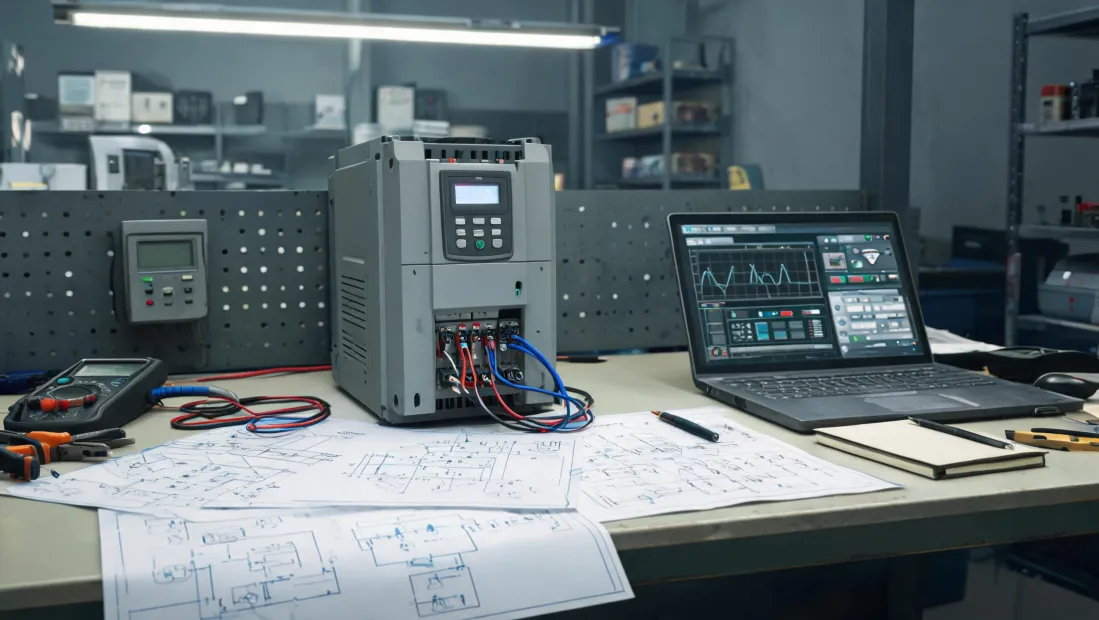
March 11, 2025. 4:47 PM. My phone rang.
The caller was a parts manufacturer we'd supplied for three years. Monday morning, a Yaskawa V1000 VFD on their main assembly line had failed. By Tuesday afternoon, they'd given up on a repair. By 4:47 PM, they were panicking.
Their shipping window closed Friday at 5 PM. Miss it, and a penalty clause in their contract with an OEM customer kicked in. If I remember correctly, it was around $40,000 in penalties, plus roughly $11,000 a day in idle-line costs.
Forty-eight hours. One Yaskawa VFD. A stopped factory.
I've been coordinating rush logistics at an industrial automation distributor for six years. I've handled several hundred emergency orders — from a single contactor to an entire PLC rack. But VFD orders are a different animal. They're heavy, they usually ship freight, and because the supply chain is layered, a distributor rarely has the exact model you need sitting on a shelf.
So we started making calls.
Three quotes. The cheapest one looked like the obvious pick.
By 9 PM Tuesday, we had three quotes in hand.
An East Coast supplier came in lowest. A Midwest wholesaler was about $340 higher. And a regional partner we'd worked with for two years quoted roughly $680 above the cheapest option.
The procurement team naturally pushed for the lowest number. That instinct is baked into every purchasing training program: put the quotes side by side, choose the smallest figure.
But something made me pause.
The East Coast supplier's email had a line buried near the bottom, almost invisible: "*Stock subject to warehouse verification; West Coast inventory may be depleted within this window. Estimated lead time 7–10 business days." Grey text, just above the signature, like an afterthought.
I called. The rep said, "We've got one last unit. It should be available per-stock."
I said OK, and hung up. But something felt off.
(And by the way — every drive distributor buying guide I'd ever read said the same thing: get at least three quotes, then pick the cheapest. That buried line was exactly the kind of detail you only start noticing after you've been burned.)
Four hours later, the story changed.
Around 1 AM Wednesday, the East Coast rep emailed: "Apologies — system showed a stock discrepancy. That model requires a special order. Lead time 7–10 business days."
I closed my laptop and stared at the ceiling. The client's production manager had already told me plainly: "Money is secondary. I need that machine running by Friday."
At 6 AM, I started calling again. The Midwest wholesaler confirmed they had one V1000 on the shelf. The regional partner had one too — and they threw in something extra: remote configuration support from a Yaskawa-trained technician.
That turned out to matter more than anything else.
The client didn't have anyone in-house who was comfortable with VFD parameter setup. Their electrician could handle basic wiring, but programming a V1000 — the 200+ parameters, switching between V/f and sensorless vector modes, setting carrier frequency — that was outside their wheelhouse.
We went with the regional partner.
Shipped. Delivered. Line running by 11:03 AM Friday.
The distributor shipped Wednesday afternoon. It arrived Thursday morning. Their tech spent Thursday afternoon on a remote session walking the client through configuration and a test run.
Friday at 11:03 AM, the line was running again.
We paid $680 more than the lowest quote. Here's what that $680 bought:
- Verified physical stock (not a "should be available")
- Two-day freight instead of 7–10 business days
- Included Yaskawa VFD tech support — no separate emergency programming fee
- Zero penalty exposure, zero additional downtime
Now compare that to the alternate path. If we'd gone with the cheapest quote: 7–10 day lead time, guaranteed missed deadline, $40,000 penalty, plus daily idle-line costs that would have ballooned past $100K by the time a replacement arrived.
The math isn't close.
The lesson I should have learned earlier
That night changed how I evaluate supplier quotes permanently.
I now calculate Total Cost of Ownership before comparing anything. For VFDs and bulk PLC orders, that means:
- Unit price — the number everyone looks at first
- Freight and duties — VFDs often ship oversized; it's rarely baked in
- Configuration / tech support — included or extra? This alone can swing a decision
- Lead time risk — what happens to your operations if the shipment slips?
- Emergency re-sourcing cost — if the first order fails, what does the backup cost?
I'm not an automation engineer, so I can't speak to whether the V1000 or a GA700 makes more sense for a given torque profile. That's outside my lane. What I can tell you from coordinating rush orders is this: the lowest quote is rarely the lowest cost.
And one more thing — if you're sourcing bulk PLC modules, relay distributor stock, or a mix of contactors and timers alongside your VFD orders, evaluate the distributor on lead-time reliability and support capability, not just the line-item price. The vendor who picks up at 1 AM when your line is down is worth more than the $300 you saved going with someone else.
If I remember correctly, that client placed three more orders with the regional partner within the next six months. Not because they're the cheapest. Because they're the ones who actually deliver.
Bottom line: always get multiple quotes. But compare the full cost — time, risk, and support included — not just the number on the quote sheet. That 1 AM "sorry, out of stock" email will always cost more than the $680 you tried to save.