
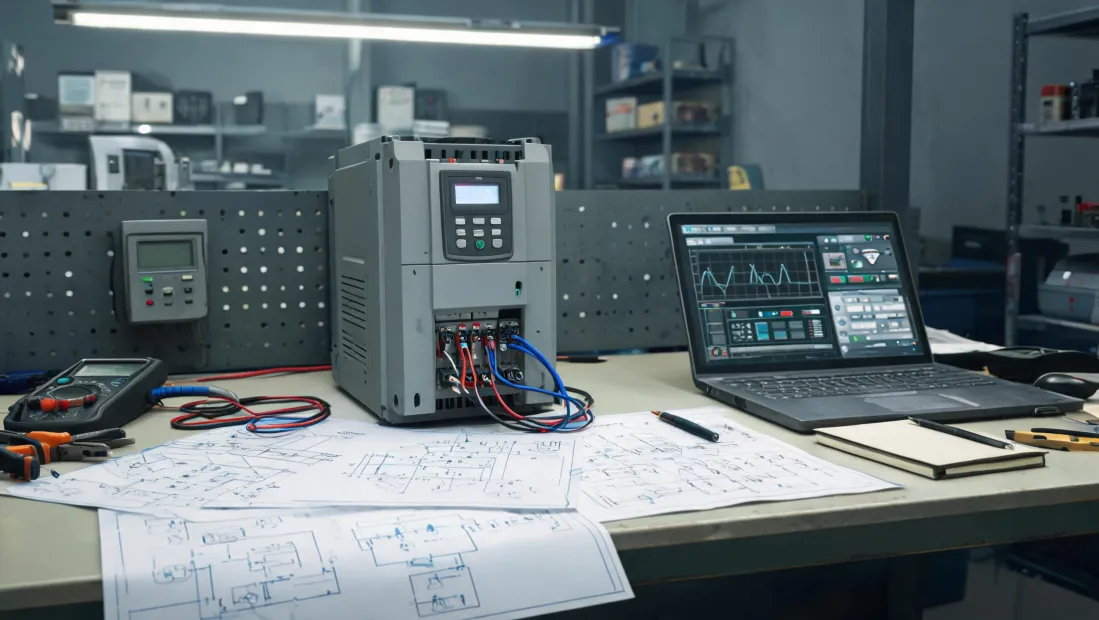
Thursday, 3:47 p.m. A purchasing manager from a food-processing plant is on the phone. A 30 HP Yaskawa V1000 VFD on their wastewater pump faulted and tripped the line. They don’t keep a spare, and he needs a replacement before the next shift starts—or he’s explaining a production halt that nobody is going to like.
We get a version of that call almost every week. In my role coordinating emergency orders for an industrial controls distributor, I’ve handled 200+ rush jobs over the last four years, including same-day turnarounds for plants that had run out of options. The experience pushed me to a clear conclusion: the buyers who get through emergencies fastest aren’t the ones who find the fastest shipper. They’re the ones who made decisions before the emergency existed.
That’s what this article compares: scramble-buying versus planned sourcing when you need Yaskawa VFD drives, safety PLCs, and other control components. I’ll compare them on four dimensions—total cost, real-world speed, compliance, and how the repair holds up afterward.
Two Ways to Handle the Same Breakdown
When a Yaskawa VFD fails, buyers split into two groups.
The scramble group starts calling suppliers after the failure. They ask for the cheapest unit that can ship today, pay for hot-shot freight, and hope the part is right. The hope part is the problem.
The planned group has already done the unglamorous work: they know which motors are critical, they keep a spare drive or a documented exchange agreement for the risk-rated ones, and they can pull the exact part number from their controller catalog or asset file. When they call, it’s a transaction, not a search.
Both groups call us in emergency mode eventually. The difference is what happens after the phone call—and what it ends up costing them.
The Cost Dimension: Sticker Price Isn’t the Cost
Most buyers focus on per-unit pricing and completely miss expedite fees, freight, overtime labor, and the quiet cost of getting the wrong part. Based on our internal tracking across 200+ rush jobs, a genuinely urgent Yaskawa VFD order carries a premium of roughly 22–38% over the same unit ordered through a planned wholesale program. The drive itself is the same. The circumstances around it aren’t.
People assume rush orders cost more because they’re harder to fulfill. The reality is they cost more because they’re unpredictable and disrupt planned workflows. Inventory gets pulled from other projects. Technicians get yanked off scheduled work. A distributor’s stock allocation gets rearranged. Somebody pays for that disruption—and in a scramble, it’s your purchase order.
Planned sourcing changes the math. If you have a contract with a genuine Yaskawa VFD distributor, or you’re buying VFD drives in scheduled quantities, the pricing and freight look completely different. The same logic applies to smaller components. When you choose timers for wholesale orders on a schedule, the supplier can consolidate shipments and hold stock for you. You can’t expect a broker to do that at 10 p.m.
The conclusion here isn’t close: planned sourcing wins on total cost in almost every scenario. The only reason it looks otherwise is that too many buyers compare the sticker price of a rush order with the sticker price of a planned one—and miss the 30% buried in the chaos.
The Speed Dimension: The Answer That Surprised Me
Here’s where the conventional wisdom breaks.
Scramble buying feels faster. You need a drive tomorrow, so you find the supplier who says they can deliver tomorrow. But most buyers ask, “How fast can you ship?” The question they should ask is, “How sure are you that this part is correct and genuine?” In 200+ rush orders, I’ve seen “new” Yaskawa VFD units with scratched serial numbers, counterfeit labels, and internally relabeled parts that were never built to Yaskawa’s specification. Those discoveries usually happen after the drive arrives—which means the rush shipment didn’t save time. It consumed the time you didn’t have.
The speed of an emergency replacement isn’t really about shipping. It’s about part identification, verification, and configuration. Only one of those steps can be expedited by paying more. The others require information that either exists before the failure or has to be rebuilt during the worst possible moment.
In March 2024, a Louisiana packaging plant needed three safety PLCs for a machine-guarding expansion. Their deadline was brutal: a compliance audit was 36 hours out, and the normal lead time on those PLCs was around two weeks. The scramble instinct would have been to call five brokers and take whoever had stock. Instead, they pulled exact part numbers from their controller catalog, called us with a prior purchase reference, and asked what documentation would ship with the units. Because the spec was verified in minutes, we got the safety PLCs to them overnight, and their panel shop installed them before the auditor arrived. Their alternative was shutting down three lines—roughly $50,000 in lost production—while they waited for the next available broker shipment.
That’s the counterintuitive dimension: even in a true emergency, the planned path is usually faster. The plan doesn’t eliminate the rush. It eliminates the guesswork that turns a one-day rush into a five-day disaster.
The Compliance Dimension: When “It Works” Isn’t Enough
Speed and cost matter only if the component is actually allowed to run in your facility.
Safety-rated parts sit in a different category from standard controls. A safety PLC, safety relay, or safety contactor isn’t just a component with extra features; it’s part of a documented safety function. A responsible safety PLC distributor can provide the Declaration of Conformity, SIL-related data (for example, under IEC 61508), and serial-level traceability. Buy the same-looking unit from an unverified channel and you might get a functional box—without the paperwork that proves the safety case. If an auditor or investigator ever asks why this part was used in a safety circuit, “It worked on the bench” isn’t an answer.
The same idea applies to Yaskawa VFD drives in motor circuits. The National Electrical Code (NFPA 70) addresses motor circuits and controllers in Article 430, and plant inspectors routinely look for listed equipment. When you buy through a legitimate supply channel, the unit should carry the required listing marks and a serial number the manufacturer can trace. A gray-market unit with the same label doesn’t necessarily carry the same compliance status—no matter how identical it looks.
Conclusion on this dimension: the scramble path isn’t just more expensive. For safety-related applications, it’s usually disqualified. When you need a safety PLC, choose a safety PLC distributor who provides the documents with the hardware. If they can’t, you haven’t bought the same part.
What 200+ Rush Orders Taught Me
Here’s the pattern after four years of emergency orders: the customers who call us most often are rarely the best prepared. The customers who call us least are the ones who recover fastest when something does fail.
I remember an automotive tier-one supplier that had a VFD failure on a critical cooling fan. They had a risk-rated spare in the maintenance crib, the motor nameplate data taped to the cabinet door, and the parameter file backed up in the control system. Their electrician swapped the failed unit in about forty-five minutes. We didn’t need to air-freight anything. The whole event cost them a few hours of reduced capacity, not days of downtime.
Compare that with the plant that buys from whichever source offers the lowest quote that week. When their drive fails, they don’t know the exact model, they don’t know if the replacement is genuine, and they don’t have the documentation to prove it either way. That’s the difference between an inconvenience and a catastrophe.
I’ll admit I wasn’t always disciplined about verification. In 2023, after the third emergency V1000 order turned out to be the wrong voltage class, our team added a nameplate checklist to every rush form. It takes maybe five minutes to confirm the serial number, model code, and voltage class before we ship. If that process feels bureaucratic, I’ve seen what happens when you skip it: a $2,000 rush drive delivered overnight to a plant where it can’t be used. A five-minute check saves a five-day correction. That lesson applies on both sides of the counter.
Which Approach Should You Choose?
There’s no universal answer, but the scenarios point in clear directions.
If your line is down right now
Stop comparing prices and ask three questions: Is the unit physically in stock? Can you verify it’s a genuine Yaskawa VFD, not a counterfeit or relabeled unit? What documentation ships with it? Choose the supplier who answers all three, even if it costs a little more. A second failure will cost far more.
If you run continuous processes on VFD drives
Standardize your critical spares. Identify the motors you can’t afford to lose, choose one Yaskawa VFD model for each risk category, and store a genuine spare or set up a documented exchange program. Keep the part numbers in your controller catalog or maintenance system so anyone on any shift can find them.
If the component is safety-rated
Use a safety PLC distributor that provides certificates and product traceability. If a “deal” doesn’t include the documentation, it isn’t a deal—it’s a future audit finding.
If you’re choosing timers for wholesale orders
If you’re wondering how to choose timer for wholesale, the starting point is never the unit price. Start with the application: input voltage, timing function (on-delay, off-delay, or interval), time range, contact configuration, and the electrical rating of the output contacts. When those are locked in, quantity pricing becomes the last thing you compare, not the first. Choosing timers this way prevents the $9 part that costs $900 in installation labor to replace.
Prevention beats correction every time. I’ve watched that play out across 200+ emergency orders, and I’d rather help you build a plan than rescue you from the absence of one. Five minutes of verification is cheaper than five days of downtime—even at 3:47 on a Thursday afternoon.