
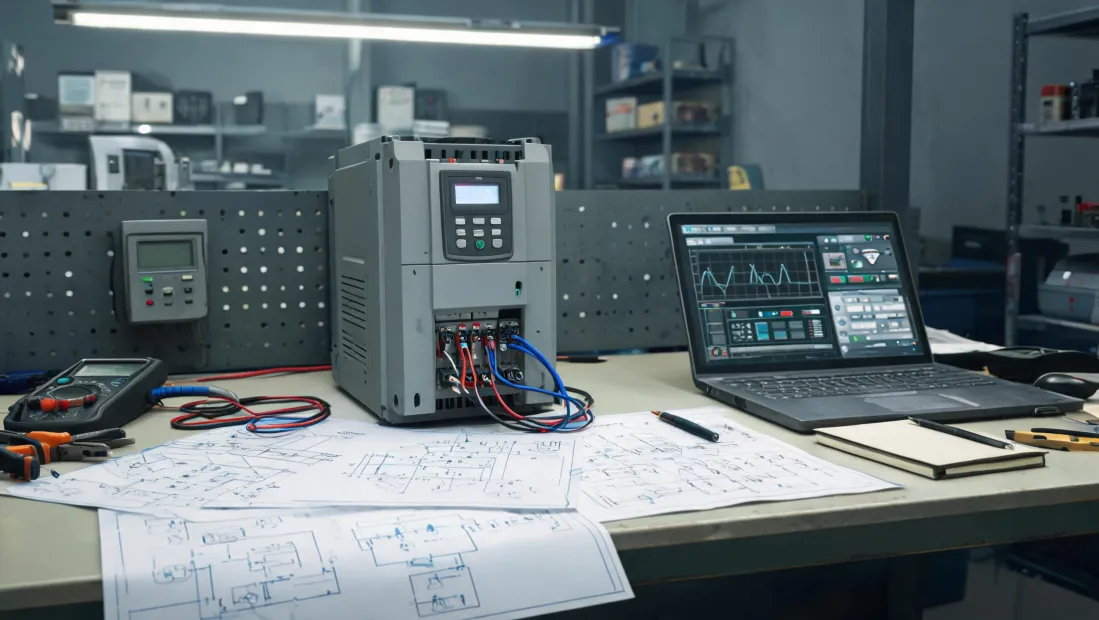
6:40 a.m., March 2025: The line was down
I'm a maintenance procurement lead. I've been handling VFD and industrial control orders for 9 years. I've personally made and documented 7 significant mistakes, totaling roughly $18,400 in wasted budget. Now I maintain our team's pre-check list. This post is one of those mistakes. It's the one that finally made me stop treating drive OEM vs private label as a paperwork problem.
In March 2025, at 6:40 a.m., our packaging line stopped. The operator called me before I'd had coffee. A Yaskawa V1000 VFD had faulted, and the line wouldn't reset. We had a spare drive on the shelf. I thought we were covered.
We weren't.
The spare that wasn't
The spare was a private-label drive. We had bought it 14 months earlier from a distributor who promised it was a drop-in replacement for the Yaskawa VFD. The nameplate voltage and kW matched. The price was 38% lower. At the time, that felt like a win.
It was a classic oversimplification: it's tempting to think a VFD is a VFD as long as the specs line up. But a drive is not just a power stage. It's firmware, parameter architecture, fault diagnostics, warranty path, and tech support.
We installed the private-label drive. It powered up. Then the parameters wouldn't match our PLC logic. The acceleration ramp was different. The fault codes didn't line up with our maintenance manual. We called the distributor's support line. They told us to email. We emailed. Then we waited.
That's when I called Yaskawa VFD tech support. I should add that I'd assumed they'd help with any drive that looked similar. They didn't. The technician was polite but clear. He asked for the Yaskawa VFD model and serial number. I gave him the private-label drive's info. He explained that without a genuine Yaskawa VFD, he couldn't walk me through the parameter set or honor the support path.
According to Yaskawa's official support portal (yaskawa.com), have the model, serial number, and fault code ready before contacting Yaskawa VFD tech support. Source: yaskawa.com, accessed April 2026.
I'm not saying private-label drives are always junk. Some work fine in low-demand applications. But when your line is down and you're staring at a fault code that doesn't match the manual, the support path matters more than the discount.
The relay supplier problem hiding in plain sight
While I was fighting the drive, our electrician found a second issue. A relay on the same panel had welded closed. We'd bought that relay from a low-bid relay supplier six months earlier. The relay looked identical to the OEM part. Same pinout. Same coil voltage. But the contact material and load rating were not the same. The datasheet was vague. The supplier's answer was vague.
Most buyers focus on unit price and completely miss the support path: who answers when the relay fails at 2 a.m.? The question everyone asks is, how much is the relay? The question they should ask is, what happens when this relay fails and the line goes down?
4 hours to decide, no time for three quotes
By 10:15 a.m., we had a choice. We could keep chasing the private-label drive and the low-bid relay supplier, or we could pay for certainty. Had 4 hours to decide. Normally I'd get three quotes and compare lead times, warranty, and support. But there was no time. Went with a higher-priced industrial supplier that stocked genuine Yaskawa VFDs and had the correct relay in stock.
The quote was $420 more than the cheapest option. The cheapest option was 'probably' going to ship in 2 days. The higher-priced supplier guaranteed same-day shipping and gave us a direct Yaskawa VFD tech support path if we needed help with parameters.
We paid the $420.
In hindsight, I should have pushed back on the original purchase 14 months earlier. But with the line down and the CEO waiting, I made the call with incomplete information. The $420 felt painful. Missing a $15,000 production window would have felt worse.
The fix, and the real cost
The genuine Yaskawa VFD arrived at 2:10 p.m. The relay arrived with it. We installed the drive, loaded the correct parameters, and called Yaskawa VFD tech support to verify the setup. This time, the technician had the model and serial number. He walked us through the fault history and the parameter checks. We were back up by 4:30 p.m.
If I remember correctly, our downtime cost was around $2,800 per hour, though I might be misremembering the exact figure. Either way, the 6-hour outage was already expensive. The private-label detour added roughly 3 hours of troubleshooting that never should have happened. The relay failure added another 45 minutes.
That night, I added up the waste. The private-label drive was $680. The relay was $22. The emergency freight was $420. The overtime was $310. The scrap was $1,150. The total mistake, including the original private-label purchase and the low-bid relay, was about $18,400 when I factored in the downtime and the customer credit. I documented all of it.
What I changed in our checklist
After the third rejection in Q1 2024, I created our pre-check list. This March 2025 incident forced a rewrite. Here's what we now verify before any Yaskawa VFD, relay, or drive purchase:
- Drive OEM vs private label: We don't just compare nameplate specs. We verify the model is a genuine Yaskawa VFD, check the serial number, and confirm the firmware and parameter set match our machine.
- Yaskawa VFD tech support path: We confirm the supplier can provide genuine support access. If the supplier can't tell us how to reach Yaskawa VFD tech support, we don't buy.
- Relay supplier qualification: We check contact material, load rating, cycle life, and agency certifications. We ask for the datasheet before the PO, not after the failure.
- Emergency premium: We now budget for rush delivery on critical spares. In an emergency, the cheapest option is often the most expensive one.
It's tempting to think you can save money by buying private-label drives and low-bid relays. But the total cost includes the troubleshooting, the downtime, and the credibility hit when your line is down and you can't answer the CEO's question.
The lesson I keep relearning
Time certainty is worth paying for. In March 2025, we paid $420 extra for rush delivery. The alternative was missing a $15,000 production window. That's the math I use now. I'm not saying you should always buy the most expensive option. I'm saying that when the line is down, the premium for a guaranteed delivery and a genuine Yaskawa VFD support path is cheap compared to the cost of guessing.
This was accurate as of April 2026. VFD firmware, lead times, relay availability, and support policies change fast, so verify current details with your supplier or Yaskawa's official support portal before you commit. I learned these vendor evaluation criteria in 2020. The landscape may have evolved, especially with new drive options and supply chain shifts.
If you're building your own pre-check list, start with the support path. Ask: when this Yaskawa VFD faults, who answers? When this relay fails, who replaces it? If the answer is 'email us and wait,' you're not buying a part. You're buying a future emergency.