
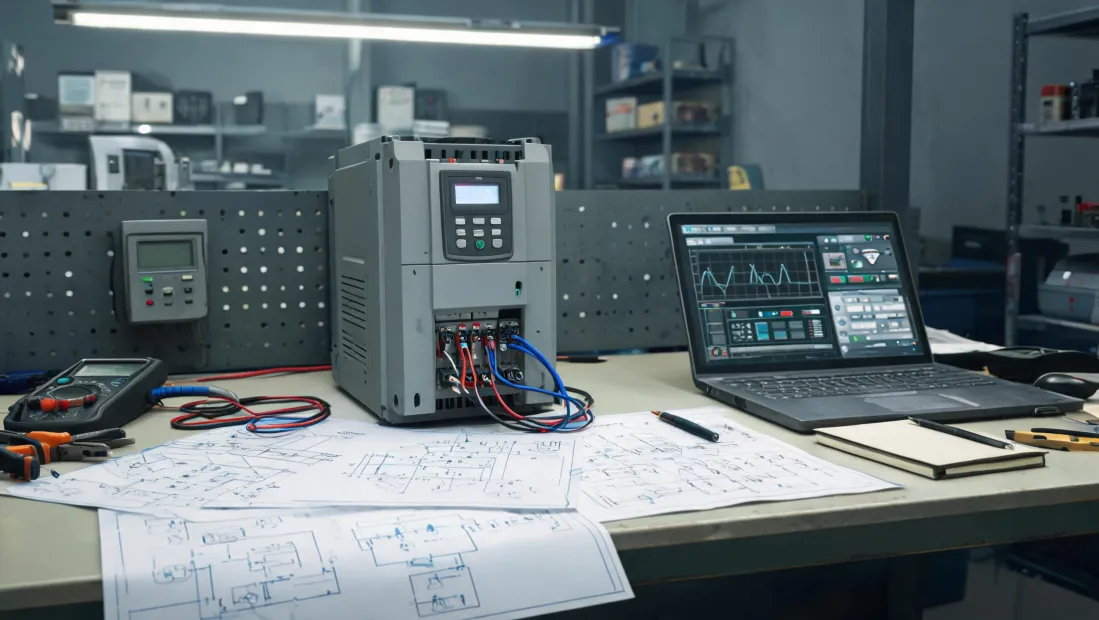
It was 4:47 PM on a Friday when my phone rang. The caller was a maintenance manager at an automotive parts plant in Michigan. His line was down—a Yaskawa VFD had failed mid-shift—and he needed a replacement before Monday morning's 7 AM start. Not a similar drive. Not a "comparable" model. The exact unit.
I've been coordinating emergency orders for an industrial supply company for three years now. I've handled 200+ rush jobs, including same-day turnarounds for OEMs and distributors who couldn't afford to wait. You'd think I'd be used to it. But every call still tightens something in my chest, because I know the math: 47 hours isn't a lot of time when you're dealing with industrial electronics.
Here's what most people don't realize about "in stock" in this industry: it's often a warehouse somewhere, not your warehouse. And the gap between those two realities is where projects die.
The First Two Calls (Or: Why Cheap Quotes Make Me Nervous)
First supplier: website said "in stock." I called. "Well, that's our factory stock indicator," the rep told me. "Ships in 3-5 business days."
That's the thing about standard turnaround—it usually includes buffer time that vendors use to manage their production queue. It's not necessarily how long your order takes. But when you're staring down a weekend deadline, buffer is a luxury you can't afford.
Second supplier: claimed to have the Yaskawa VFD. The price was 30% below market. I asked for the serial number and batch code.
A long pause.
Turns out it was a refurbished unit, repackaged to look new. Not counterfeit, technically—but not what the customer ordered either. And with a production line waiting, there's no room for a drive that might fail again in six months. A bad VFD doesn't just stop one machine. It can take out the PLC, stress the contactors on the same circuit, and cascade into everything downstream.
I get why people go with the cheapest option—budgets are tight everywhere. But the hidden costs of a marginal VFD add up fast (replacement labor, secondary failures, downtime at $2,300/hour).
The Call That Changed the Order
Third supplier: a Yaskawa authorized distributor I'd worked with before. About 18% more expensive than the cut-rate option. They did three things that earned my business.
First, they checked actual shelf inventory—not just a system status. They gave me a batch number and a date code I could verify.
Second, they asked about the surrounding components. "What contactor is that drive paired with? Can the PLC handle the re-start sequence if the replacement has a different firmware revision?" Those aren't upsell questions. They're compatibility questions, and they matter. A VFD doesn't run in a vacuum.
Third, they committed to Saturday afternoon delivery. That put us at roughly 41 hours from the initial call. Tight but doable.
We placed the order: Yaskawa VFD, a matched contactor set, an overload relay from the same distributor, and a comms cable to tie it back to the PLC. Everything from one handshake, so there was no finger-pointing if something didn't fit.
Where It Almost Fell Apart
Saturday noon. Twenty-six hours to go.
Carrier update: weather delay. Estimated arrival Sunday afternoon.
That left maybe 14 hours of contingency, most of which would be eaten by installation and calibration. Not acceptable.
I called the Yaskawa distributor. No deflection, no "not our problem." They pulled up the carrier's routing, found an alternate line that hadn't scanned properly, and re-routed the shipment. It arrived Saturday at 8:14 PM.
Take this with a grain of salt: I'm not sure that would work with every supplier. Some just don't have the logistics bench to make that call. But that's exactly why you vet them before the emergency, not during it.
Monday Morning
6:02 AM. The maintenance team dropped in the drive, wired it up, powered on. First try.
Production started at 7:00 AM on the nose. The floor never noticed anything happened.
There's something satisfying about a perfectly executed rush order. After all the stress and coordination, seeing it delivered on time and correct—that's the payoff. But the real win was what the procurement manager said afterward: "If we'd kept a spare drive on the shelf, none of this would've happened."
What I'd Do Differently (And What I Now Do Every Time)
That Monday, I built a checklist. It's saved us—conservatively—$12,000 in rework and emergency freight over the past year.
Verify the stock, not the status. Don't ask "do you have it?" Ask "is it on a shelf, what's the batch number, and when does it ship today?" That question filters out 80% of suppliers who can't deliver on a bad day.
Price is only one number. The cheap VFD quote was $340 lower. Factor in downtime, expedited freight on the recovery order, and the risk of a second failure—the math stops making sense quickly.
Build the relationship before you need it. The distributor who saved us wasn't a cold call. We'd placed three smaller orders with them earlier in the year, paid on time, and established a track record. That history is what gets your call answered on a Saturday.
To be fair, this approach requires more upfront work. You have to research suppliers, verify credentials, and build relationships when there's no urgency. But it beats the alternative: scrambling at 5 PM on a Friday with a line down and no plan B.