I stopped treating the lowest quoted number as a real comparison point years ago. It isn't. It's a number that hasn't finished growing yet.
I'm the procurement manager at a 250-person machine builder. I've owned our electrical components budget — Yaskawa VFDs, safety PLCs, timers, contactors, and the spare parts that keep three production lines running — for seven years. Last year that budget was around $1.4M, spread across roughly 40 vendors. I log every PO in our ERP with a landed-cost field I built myself, after getting burned twice on "all-in" quotes that turned out to be "most-of-in."
Here's my position, stated plainly: a vendor that shows you the full cost structure — even when the total looks higher — will almost always cost you less than a vendor that undercuts on the headline number and recovers the difference later. That's true whether you're buying Yaskawa VFD drives, sourcing a safety PLC from an OEM channel, or picking a timer supplier for a panel that ships 400 times a year.
I've got the invoices to back it up. Let me show you three places where the gap lives.
The VFD price you're quoted is maybe 70% of what you'll actually spend
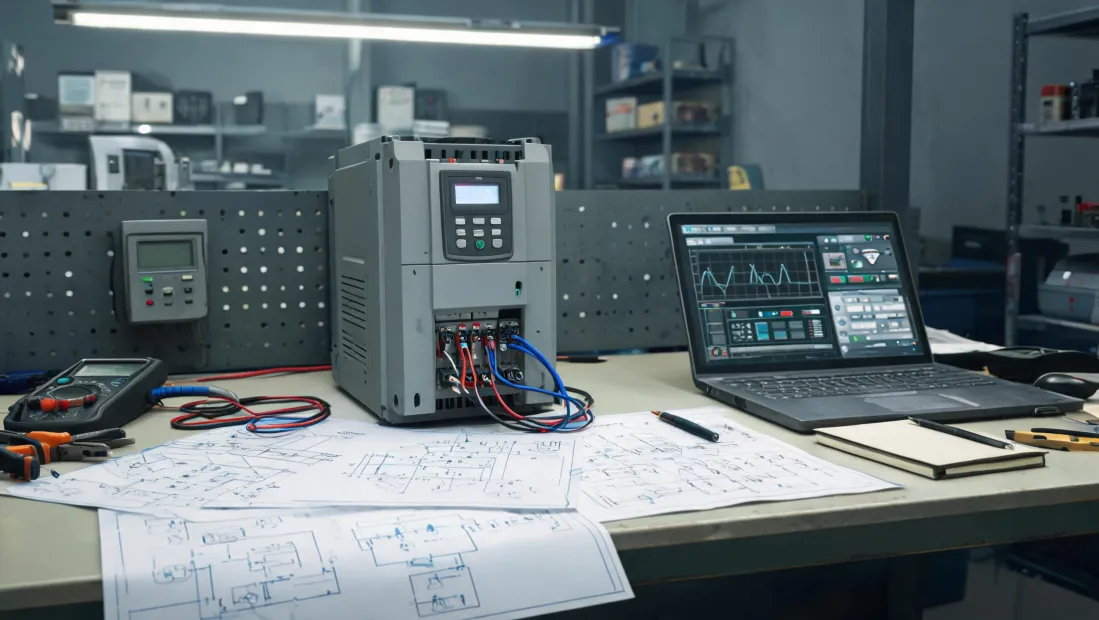
When we compare Yaskawa VFD quotes, the unit price is the easy part. What's harder to compare is everything attached to it.
Four years ago I bought a batch of drives from a reseller who came in about 18% under the authorized channel. Same model number, same specs on the spec sheet. The drives arrived in three weeks — a week later than promised — and two of the six had firmware that didn't match our existing parameter sets. We'd standardized on a specific firmware revision because our machine programs clone parameters across the line, and a mismatch meant every one of those units needed a manual setup pass instead of a file copy.
That's the kind of thing that never shows up in a quote. It shows up in engineering hours, in startup delays, and in the third shift that stays late because line two isn't running.
I knew I should have gotten written confirmation on the firmware revision before releasing the PO. I told myself "it's the same part number, what are the odds?" The odds caught up with me on a Friday afternoon with a customer's commissioning date the following Monday.
So now the checklist for any Yaskawa VFD supplier looks like this:
- What firmware revision is shipping? Part numbers stay the same across revisions. Behavior doesn't.
- Is the unit traceable to an authorized distribution channel? Not a hint. A serial number and a documented chain.
- What happens if a drive fails in month 14? Warranty terms change dramatically depending on where the unit originated.
- Does the quote include the parameter set, the manual revision, and the mounting hardware? Or is that all "available separately"?
On the last point — for reference, our own quote log puts the authorized-channel-to-gray-market spread on comparable drives somewhere in the 10–20% range as of early 2025. That's a real number. What it doesn't tell you is the cost of a startup you have to redo, which on our machines runs into four figures per incident. Verify current pricing with whoever you're buying from; it moves. But the ratio between the discount and the risk has held pretty steady in my experience.
Safety PLC sourcing: the certificate is the product
Safety PLC sourcing is a different animal from general component purchasing, and I think a lot of buyers don't fully internalize that until their first audit.
The functional safety documentation — the manufacturer's safety manual, the SIL or PL verification data, the proof-test intervals — is not a nice-to-have. It's part of the deliverable. Machine safety applications in our world typically need to demonstrate compliance against ISO 13849-1 (Performance Levels a through e) or IEC 62061 (SIL 1 through 3), both of which trace back to IEC 61508 as the foundational standard. If your supplier can't hand you the safety manual for the exact firmware and hardware combination you're installing, you don't have a safety PLC. You have a PLC that someone described as safe.
I learned that the slow way. I told one OEM channel I needed "our standard safety PLC." They heard the same words. What I meant was the specific family we'd been using for two years, with the existing panel layout and the existing wiring scheme. What they meant was any unit that met the functional requirements on paper.
The order arrived. It met the requirements. It also needed a different terminal arrangement, and our panel design had to be modified. That's a change order, a drawing revision, and a requalification of the enclosure. All told, roughly 40 engineering hours for a line item that was 6% cheaper than the alternative.
So when I evaluate a safety PLC OEM channel now, I ask three things before anything else. Can you send the safety manual for this exact part number? Can you confirm the certificate references the hardware revision you're shipping? And who do I call at 7 p.m. on a Thursday when the system faults out and the line is down? The vendor who can answer all three without hedging is worth a premium. The one who has to "check with the factory" on the first two and can't name a support contact on the third is a red flag, no matter what the quote says.
What to look for in a timer supplier — and why it's not the per-unit price
This is the counterintuitive one. Timers are cheap. A basic DIN-rail timer is a few dollars to maybe a few dozen dollars per piece, depending on the function and the certifications. At that price point, buyers naturally shop on unit cost.
I did that. It cost us more than the timers did.
Three years ago we switched to a supplier who came in roughly 22% under our previous source. The first order was fine. The second order was fine. By the fourth order, we were seeing field failures — timers drifting outside their specified tolerance after about 18 months in service, which on our equipment meant intermittent fault trips and unplanned line stoppages that our service techs had to chase down with a stopwatch.
Rough count: about 8 units out of every 100 drifted out of spec within the warranty window. Each one triggered a service call. Each service call averaged several hundred dollars in labor and travel, plus the customer's downtime. We spent more in one year on service calls for those timers than we'd saved on three years of purchasing.
So here's what I actually look for in a timer supplier now. Not the price. The batch consistency — I want to see tolerance data, not a marketing line about "precision manufacturing." The discontinuation policy — how much notice do I get if they're ending a model, because re-certifying an alternative in a shipped panel is expensive. And the documentation — a UL 508 listing or an IEC 60947-5-1 conformity statement that references the actual model, not the product family.
Then again, I have mixed feelings about the whole approach. Part of me thinks we're over-engineering a decision that used to be about a few cents per unit. Another part remembers the fourth quarter of that year, when my service manager called me to ask why we were seeing so many timer faults, and I had to admit I'd made the switch on price. I'll take the documentation burden over that phone call.
One more thing worth flagging: the cheapest timer supplier in our comparison also had the slowest quote turnaround. Took five days to get pricing on a second order. At the time it felt like an annoyance. In hindsight it was a preview — the same slowness showed up in their delivery performance six months later. Every spreadsheet said go with them. Something felt off. I should have listened to the feeling sooner.
"But can't you just negotiate the extras away?"
Fair question. And yes, sometimes you can. But negotiation only works on a cost structure you can see.
If a supplier tells you up front that there's a $180 setup charge, a $95 documentation fee, and a 4-week lead time with a 12% expedite premium if you need it faster — you can negotiate against those numbers. You can bundle. You can trade volume for the expedite waiver. You can plan around the lead time. All of that is possible because the numbers exist on paper.
What you cannot negotiate against is a line item that hasn't been invented yet.
The "cheapest" vendor in a comparison is often the one with the most invisible costs, because those costs were the reason the price was low. They're not being withheld maliciously in every case — sometimes the vendor genuinely doesn't know how much the post-sale support will cost. But from your side of the table, the effect is the same: you underwrite the uncertainty.
I also want to be clear that transparent pricing does not automatically mean lower pricing. Sometimes it means higher. We've paid 8–11% more on certain line items to work with suppliers who publish their full cost structure and answer documentation requests in under 24 hours. That premium is a real cost. The difference is that I know exactly what it is, I can defend it to my CFO with numbers, and I'm not waiting for a surprise to show up in Q3.
Bottom line
I'm not arguing that cheapest is always wrong. I'm arguing that cheapest is unverifiable when the full cost isn't disclosed, and an unverifiable number is not a useful input into a sourcing decision — whether you're buying Yaskawa VFD drives, a safety PLC from an OEM channel, or a timer that costs less than the shipping label on the box.
What I'd ask of any supplier, in any of those categories, is one sentence: tell me everything that's included, and tell me everything that isn't. The vendors who can answer that without flinching are the ones who end up on our approved list. The ones who can't are the ones whose quote looked amazing in January and whose total cost looked very different by December.