
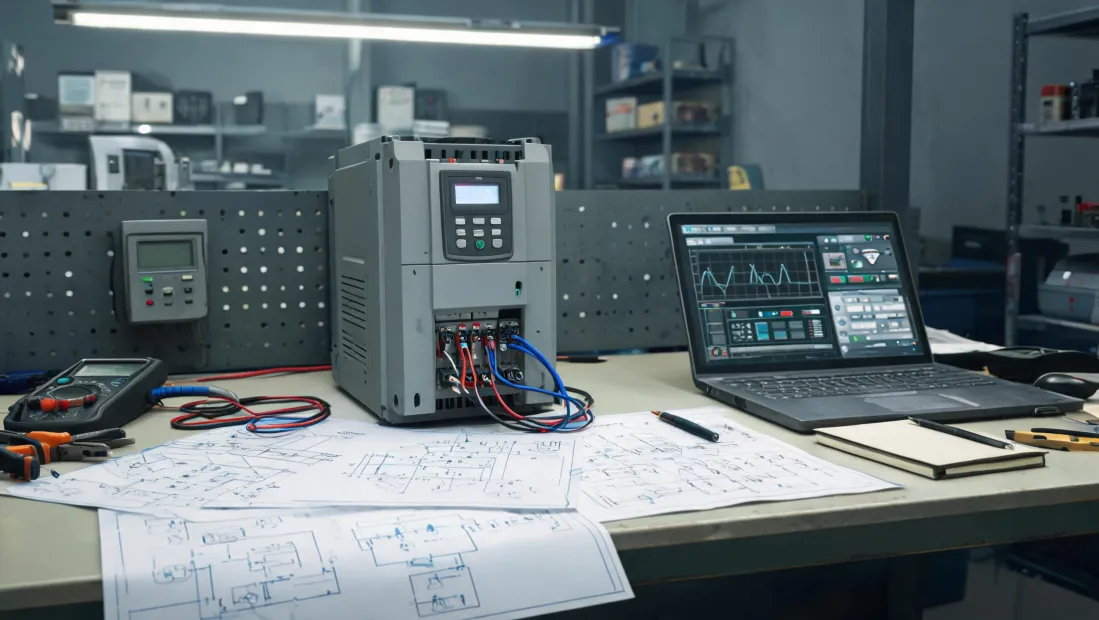
The Yaskawa VFD Order That Looked Like a Pricing Problem
In March 2024, I paid $400 extra for guaranteed dispatch on a Yaskawa VFD replacement. The alternative was missing a $15,000 production window. The drive itself was not the issue. The issue was that we almost bought the wrong one because our RFQ said “Yaskawa VFD, 10 HP, 480V” and nothing else.
I have handled industrial drive and control orders for 11 years. I have personally made and documented 27 significant mistakes in that time, totaling roughly $18,400 in wasted budget, expedited freight, and rework. I now keep our team’s pre-order checklist. Not because I am organized. Because I got tired of explaining avoidable errors to production managers.
Most buyers think the hard part of sourcing a Yaskawa VFD, a bulk controller package, or a drive private label program is price and lead time. That is the surface problem. The deeper problem is almost always incomplete information and false certainty.
The Surface Problem: Price, Lead Time, and “Can You Ship Today?”
When a line goes down, the first conversation sounds like this: “We need a Yaskawa VFD. How fast and how much?” That is a fairly natural response. Downtime is expensive. A VFD that normally takes 3-5 days suddenly needs to be there yesterday.
So buyers focus on the visible variables: unit price, stock, freight cost, and delivery date. Suppliers compete on those numbers. But the quote is only as good as the data behind it. If the model code, firmware, enclosure, keypad, network option, or motor profile is missing, the fastest quote can still be the wrong one.
I learned that the hard way in 2021. I assumed “same specs as last order” meant identical. Didn’t verify. Turned out one V1000 drive replacement had a different keypad and parameter set. The drive physically fit. It powered up. It would not run the machine without reprogramming. That mistake cost about $890 in redo plus a one-week delay. The lesson was not “check model numbers.” The lesson was “a Yaskawa VFD is not a commodity SKU.”
The Deeper Problem: A Yaskawa VFD Is a Configuration, Not a Product
Yaskawa’s official model code guides and manuals (yaskawa.com) are configuration-specific for a reason. Voltage class, enclosure type, horsepower rating, braking options, communication cards, and operator interfaces all change the part number and sometimes the lead time.
According to Yaskawa’s official documentation (yaskawa.com), VFD model codes and option numbers are configuration-specific. A quote based only on “Yaskawa VFD” and horsepower is incomplete. Verify the exact manual for your model and application.
That sounds obvious. It is not. In a rush, people copy the description from an old PO, forward a photo of a nameplate with glare, or ask for a “similar” unit. Then the supplier guesses. The buyer approves the quote because the price looks right. The error is not discovered until commissioning.
Issue 1: Yaskawa VFD Tech Support Arrives Too Late
Yaskawa VFD tech support is often treated as an after-sales resource. That is backwards. Pre-sales technical review is where you confirm firmware compatibility, parameter migration, communication protocol, and whether a replacement will behave like the failed unit.
But here is the catch: tech support cannot perform miracles with incomplete data. They need the nameplate, the application, motor nameplate FLA, control method, and fault history. If you open a ticket after the PO is placed, your options are narrower and slower. In my experience, a 20-minute pre-sales call has saved us more money than any expedited freight discount.
Issue 2: Bulk Controller Orders Hide Small Spec Errors
A bulk controller order is dangerous because one wrong line item becomes fifty wrong line items. Contactors, relays, timers, PLC I/O, power supplies, and drive accessories often get bundled into one RFQ. The unit price looks fine. The total cost of a coil voltage mismatch does not.
In Q2 2023, we ordered 50 contactors with 24V DC coils instead of 120V AC coils. On paper, the difference was one line in a spreadsheet. In the panel, it meant a two-day rework, $1,450 in wasted components, and a very unhappy controls engineer. We caught it during assembly, not at the supplier. The supplier shipped exactly what we asked for. That was the problem.
Issue 3: Timer Specification Guide Gets Ignored Until the Panel Fails
Timers look simple, so people specify them casually. But a proper timer specification guide covers function, timing range, input voltage, output contact rating, reset behavior, mounting, and enclosure. Leave out the timing range and you may get a timer that clicks at the wrong interval. Leave out the contact rating and you may get a timer that welds its contacts under load.
I skipped the final review on a timer order because we were rushing and “it is basically the same as last time.” That was the one time it mattered. Twenty-five timers with a 0.1-10 second range were specified for a process that needed 1-30 minutes. The error cost about $750 in replacements plus a three-day production delay. The buyer’s credibility took the bigger hit.
Issue 4: Drive Private Label Is Not Just a Logo
Drive private label programs can be legitimate and useful. They can also create expensive assumptions. Private label may mean cosmetic branding only. It may mean custom documentation, restricted firmware, different warranty administration, or limited technical support through the original manufacturer.
If you assume “private label” automatically means identical performance, identical support, and identical documentation to a genuine Yaskawa VFD, that is a red flag. Ask for the written scope. Who brands the label? Who handles Yaskawa VFD tech support? What happens with firmware updates? What does the warranty cover and who administers it? If those answers are up in the air, the lower price is not a no-brainer. It is a risk transfer.
Issue 5: The Cheapest Quote Often Sells Uncertainty
In 2024, we compared two vendors for the same Yaskawa VFD replacement. Vendor A was about 15% cheaper but quoted a six-week estimated delivery. Vendor B was higher but offered a guaranteed four-day dispatch. On paper, Vendor A looked better. Then we calculated downtime at roughly $2,800 per day.
When I compared the two quotes side by side, I finally understood why guaranteed delivery is not just a speed premium. It is a certainty premium. The lower quote did not include the cost of “probably on time.” We paid more for Vendor B and hit the window. That was not a procurement victory. It was avoiding a much larger loss.
What This Actually Costs
The visible cost is the unit price. The real cost shows up later:
- Rework labor: A wrong VFD or contactor can take hours to diagnose and replace. In one case, a wrong enclosure rating on three drives cost $3,900 in replacement parts plus 18 hours of overtime.
- Expedited freight: Emergency shipping is expensive. But it is cheaper than the downtime it prevents, so teams approve it without analysis. That masks the root cause.
- Production delay: A one-day delay on a $15,000 production window can wipe out the savings from a year of small price negotiations.
- Credibility damage: This is the cost nobody puts in the spreadsheet. After two bad orders, production stops trusting procurement’s lead times. Every future request becomes a fight.
We have caught 47 potential errors using our current checklist in the past 18 months. Most of them were boring: wrong coil voltage, missing keypad, unclear timer range, vague private label support terms. Boring errors are the best errors to catch, because they are cheap to fix before the PO and expensive to fix after.
The Fix Is Boring: A Pre-Order Checklist for Yaskawa VFD and Control Orders
The solution is not a secret supplier or a magic discount. It is a short, disciplined pre-order review. Here is the checklist we use now.
- Capture the nameplate. For Yaskawa VFD replacements, record the full model code, serial number, firmware version if available, and all option cards. A photo is fine, but it must be readable.
- Define the application. Motor nameplate FLA, voltage, phase, duty cycle, ambient conditions, control method, and network protocol. “Same as before” is not a specification.
- Engage Yaskawa VFD tech support early. Before the PO, not after. Ask what data they need and what risks they see. Get the answer in writing if the application is critical.
- Use a separate worksheet for bulk controller orders. One line per panel location. Coil voltage, contact rating, mounting, and terminal type. If it is not on the worksheet, it does not go on the PO.
- Follow a timer specification guide for every timer line. Function, timing range, input voltage, output contact rating, reset method, mounting, and enclosure. Do not let “standard timer” pass review.
- Get the private label scope in writing. Branding, documentation, firmware, warranty, support channel, and returns process. If the supplier cannot explain it clearly, assume nothing.
- Price certainty separately. If the deadline is fixed, compare quotes on guaranteed delivery date, not estimated date. A higher price with a guaranteed date is often the lower total cost.
- Verify genuine supply. For genuine Yaskawa VFD supply, use authorized channels and confirm serial numbers and warranty terms. Counterfeit or misrepresented stock is a problem you do not want to discover at commissioning.
Bottom line: the Yaskawa VFD and control sourcing problem is rarely just price. It is missing data, unclear private label terms, weak timer specs, and false certainty about delivery. Fix the information before you fix the price. The quote that looks cheaper often is not. The quote that confirms the part, the support, and the date is usually the one that keeps production running.
Pricing and lead times are general examples based on past project experience; verify current rates and availability with your supplier. Technical specifications vary by model and application. Confirm details against Yaskawa’s official documentation and applicable standards such as UL 508C, IEC 61800-5-1, and NEMA ICS 7.