
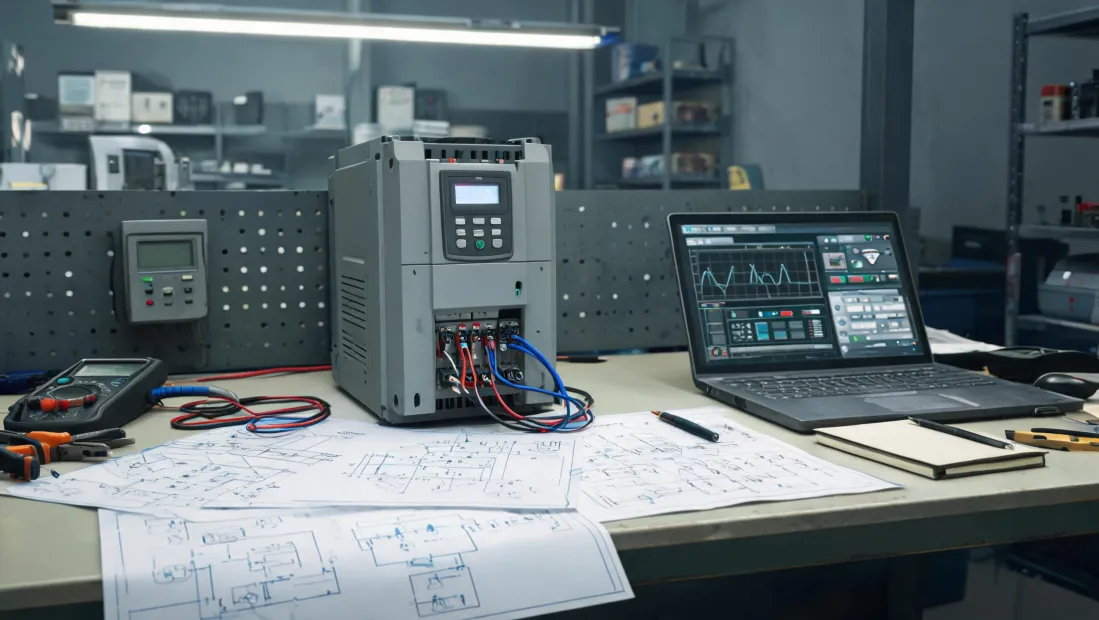
I've spent the past four and a half years as a quality and brand compliance manager at an industrial controls company. Every Yaskawa VFD and control component that goes out our door crosses my desk first—roughly 2,000 items a month. In 2025, I've rejected about 4% of first deliveries from suppliers due to spec mismatches, labeling errors, or missing documentation.
One thing that review process has drilled into my head: there is no universal answer to sourcing VFD drives and control components. The right move depends on what you're protecting, what you're building, and how much you buy. So instead of pretending one supplier strategy works for everyone, let me break it down the way I do for customers—three scenarios, three different answers.
First, Figure Out Which Buyer You Are
The real question isn't 'genuine Yaskawa VFD or private label?' or 'which relay wholesale price is lowest?' It's: what does the component actually protect? In my experience, buyers fall into three groups.
The end-user operator buys drives and relays to keep their own plant running. For them, uptime beats price every time. Then there's the OEM who builds drives into products they sell; per-unit cost and supply chain control dominate their thinking. And there's the distributor or wholesaler who stocks relays, PLCs, and drives as inventory for resale, where margin and turnover are the name of the game. Each of these gets a different answer.
Scenario 1: You're Keeping a Plant Running
If you're a maintenance engineer or plant manager replacing a failed unit, my advice is straightforward: buy genuine Yaskawa VFD drives through an authorized distributor. Not because the brand name is pretty—because you're buying predictability.
A genuine Yaskawa VFD comes with documented specs that match the catalog. You get the warranty, the programming software, the fault code references, and access to the manufacturer's technical support. That matters when an alarm shows up at 2:00 AM on a line that has to run by 6:00 AM.
I've watched operators pay way more than they saved on gray market drives. A unit that looks identical from the outside can have a different firmware revision, no serial number traceability, or documentation that doesn't match the hardware. For a critical application, that's gambling with uptime.
It's tempting to think you can just compare unit prices and pick the cheapest listing that says 'Yaskawa VFD V1000.' But that simplified comparison ignores what actually varies between sources: warranty coverage, firmware version, supplier accountability, and traceability. When I verify a drive's specs, I check them against the manufacturer's published data at yaskawa.com—not against a sales sheet. That habit has saved us more than once.
And per IEC 61800, the international standard for adjustable speed power drive systems, drive ratings are defined under specific test conditions. That's a dry way of saying: the number on the nameplate only means something if you know the conditions behind it. A genuine unit with documented ratings is the only way I'll comfortably sign off on it.
Scenario 2: You're an OEM Weighing Drive Private Label Options
If you build control panels, pumps, or conveyors that ship with a drive inside, drive private label options start to make real sense—but only under specific conditions. I've seen OEMs save a ton of money by private-labeling a drive that matches their exact application. I've also seen them get burned.
The phrase 'same internals as a Yaskawa VFD' comes up a lot in private label sales pitches. Sometimes it's true. Sometimes it's true in a way that doesn't matter, because the vendor's testing, firmware, or quality control changes the result.
Here's a concrete example from our own evaluation. We ran a private label drive against a genuine Yaskawa VFD in a cyclic load test. On paper, the power stage components were identical. In practice, the private label unit's current regulation drifted at high temperatures and tripped thermal faults, while the genuine unit held steady. Same spec sheet, different behavior.
But I am not telling you private label is wrong. For fixed-speed applications with predictable duty cycles and stable ambient temperatures, that same private label unit was completely fine, at a meaningfully lower cost. 'Fine for some jobs' and 'fine for your job' are different statements, and you have to know which one you're making.
If you're going the private label route, I'd insist on answers to these four questions before signing anything:
- What is the vendor's testing process per unit—not per batch?
- What is their documented reject rate over the last 12 months?
- Who actually develops the firmware, and how is it version-controlled?
- What happens if a batch fails your incoming inspection—rework, credit, or liability?
And get every one of those answers in writing. I still kick myself for not documenting a vendor's verbal promise about lead times on a private label order a few years back. If I'd gotten it in writing, we would have had grounds to recover the cost of the idle production time. I'm still rebuilding the goodwill that situation cost us.
Scenario 3: You're Stocking Relays and PLCs for Resale
If you're a distributor building inventory for resale, your priority flips from uptime to margin. That's not a criticism—it's the math of the business. But this is exactly where I see buyers make the most expensive mistake: evaluating wholesale cost as if unit price were the whole story.
Let's start with relay wholesale. In our Q1 2025 supplier audit, we tested 'budget' relays with a defect rate near 6% out of the box. On a 5,000-unit order, that's about 300 units that will eventually come back as complaints, returns, or field failures. The cost of processing those—testing, relabeling, shipping replacements, answering angry calls—wipes out the per-unit savings. A relay with a 0.5% defect rate at a slightly higher price is usually the smarter buy. I'd also verify the relay carries a current UL listing. That alone doesn't prove it's right for your application, but it filters out the worst of the unverified imports.
Now, the PLC wholesale cost guide. The PLC itself is often the smallest line item in the total cost of ownership. If you're stocking PLCs, factor in:
- Programming software or development time your customers will need help with
- Slow-moving SKUs that tie up warehouse cash
- Technical support burden—when the PLC acts up, the customer calls you
- Counterfeit risk in popular PLC lines, which hits distributors hardest
Here's the surprise that changed how I think about this. In one evaluation, a budget PLC platform outperformed a premium one in our specific test. Its scan time consistency was better for the application we ran, and the documentation was clearer. Never expected that. The surprise wasn't the price difference—it was how much hidden value the 'expensive' option carried for some applications, while the budget option carried it for others. Neither is universally better. Evidence is better.
But notice what has to be true for that approach to work: you have to actually test what you buy. If you don't have the capacity to evaluate incoming inventory, you have no business buying on price alone. That's not judgment—that's risk management.
How to Tell Which Scenario You're In
People ask me, 'What if I'm in two of these?' It happens. A lot of OEMs also maintain their own plant floor. A lot of distributors have an in-house panel shop. So here's the sorting test I use, and it works in about sixty seconds:
- What happens when the component fails? If the answer involves production downtime, safety risk, or a customer calling you after hours, you're buying for reliability first and price second.
- How many units are you buying? A few drives a year is a maintenance purchase. A thousand drives a year is a procurement project with room for testing, negotiation, and vendor qualification.
- What can your team actually absorb? If nobody on your side can program a VFD or diagnose a PLC fault, then even a great deal on a private label unit becomes a liability the moment something goes sideways. You end up paying with your own time.
Once you answer those honestly, the scenario picks itself. And if you're still torn, default to the conservative path: genuine components, authorized channels, and a supplier who can prove what they're selling. It's much easier to tighten costs later than it is to recover from a field failure.
The Supplier Who Knows Their Limits
One last thought, and honestly it's the one I wish more buyers would act on. You'll meet plenty of suppliers who claim they can handle everything: Yaskawa VFDs, relays, PLCs, private label work, programming, repair services—all under one roof. I've learned to be suspicious of the 'we do everything' pitch, because it usually means they do a lot of things at a passable level and nothing at a great level.
I'd rather work with a specialist who knows their limits than a generalist who overpromises. That's the standard I hold our own company to as well. We're strong at genuine Yaskawa VFD supply, control components, and repair support. When a customer asks for something outside that scope, I tell them directly, and I point them to someone who does it better. The vendor who told me 'this isn't our strength—here's who does it better' earned my trust for everything else they do. Losing one order to build a long-term relationship is a trade I'll make every time.
When you're sourcing drives, relays, or PLCs at wholesale, don't just evaluate what a supplier sells. Evaluate what they're honest about not being able to do. That honesty is the clearest signal you'll get about how they handle everything else.