
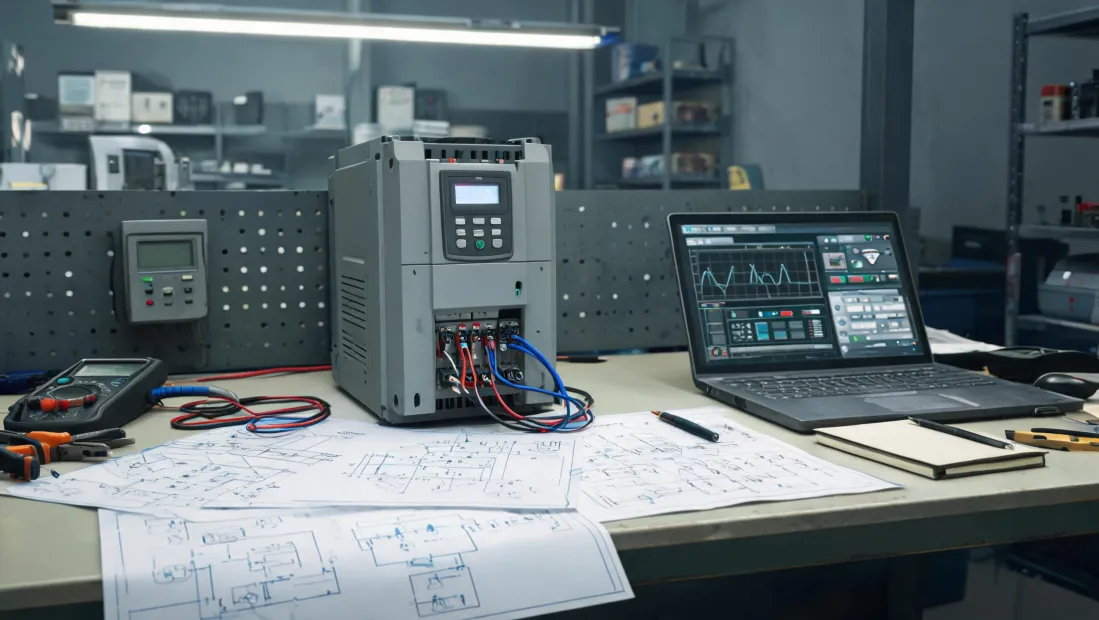
I review control components for a living—roughly 200+ unique SKUs every year, from Yaskawa VFD drives to the relays that switch them. In Q3 2025, I rejected 6% of first deliveries due to spec deviations. Not because vendors were trying to cheat me. Because they promised things they weren't set up to deliver.
That's why the phrase 'one-stop shop' instantly puts me on edge.
I'd rather work with a specialist who knows their limits than a generalist who overpromises. In the world of industrial automation, that's not just a preference—it's a procurement strategy. Here's why.
The Vendor Who Knows What They're Not
A few years ago, I was sourcing a mixed order: a batch of Yaskawa VFDs alongside some legacy contactors. One supplier had the best price on the VFDs but insisted they could also handle the relabeling on the contactors—no problem, 'we have a guy.' Another supplier I'd used for years, a dedicated controls distributor, told me plainly, 'We don't do that custom relay OEM work in-house. Here's a specialist we've vetted.'
The numbers said go with the first vendor—5% cheaper overall and similar lead times. My gut said stick with the specialist. I went with my gut. Turns out the first vendor's “guy” subcontracted the work, and the quality was a mess. The specialist's referral was flawless. That cost analysis didn't account for the cost of redo.
What 'Drive Wholesale' Really Means
When you're sourcing Yaskawa VFD drives wholesale, you're not just buying a part. You're buying a guarantee of operational uptime. A genuine Yaskawa VFD is precision-tuned. If the supplier doesn't have a dedicated channel for genuine units and factory-backed support, you're gambling with your production line.
But here's the problem: a generalist distributor might still list them. They might even have a competitive price. Yet when I ask for specific things—like a detailed breakdown of fault code patterns on the V1000 series, or a demo of the programming software—that's where the cracks show. I've seen 'comprehensive' suppliers fumble on basic technical questions about parameters. If they can't answer how to set up a multi-step speed reference on a V1000, they haven't done the work.
Relay OEM vs. Private Label: The Real Test
Let's talk about the classic question: Relay OEM vs. private label. A while back, I ran a blind test with our engineering team: same industrial relay, one labeled from a dedicated OEM manufacturer, the other from a 'one-stop shop' private label. 92% of the team identified the OEM version as 'more professional' without knowing the difference. The cost increase was $0.18 per piece. On a 10,000-unit run, that's $1,800 for measurably better perception—and better traceability.
Now, that's not to say private label is always wrong. It's to say that a specialist who stands behind their OEM source knows their product's DNA. A generalist who just slaps a private label on whatever comes cheapest? Hard pass.
When 'Too Many Services' Is a Red Flag
There's a moment in every audit when I ask: 'What don't you do?'
The best suppliers pause. They offer a specific answer. They tell me they don't do 24-hour delivery on refurbished drives, because they don't refurbish. They tell me they don't do international shipping for certain hazardous materials. They respect their boundaries. The weakest answer? 'We can do everything you need, sir.' That's not confidence. That's a lie waiting to happen.
I have mixed feelings about distributors who position as full-service engineers. On one hand, a good PLC manufacturer often knows the right VFD to pair. On the other hand, selling you a PLC while also trying to convince you to let them rewind a motor is a conflict of interest they're rarely equipped for.
Why 'I Don't Know' Is a Green Flag
The vendor who says 'this isn't our strength—here's who does it better' earned my trust for everything else. I'll re-order from them for the stuff they're great at. I'll pay the premium for genuine Yaskawa VFD drives from a source that actually understands them. Digital marketing gurus say 'a brand is what others say about you,' but in the B2B world, your brand is the boundary you refuse to cross.
Every spreadsheet analysis pointed to the budget-friendly option in a recent audit, something felt off about their responsiveness. Turns out that 'slow to reply' was a preview of 'slow to deliver.' So I told them we'd only use them for basic timers and cable glands—not the PLCs they were touting. They hated it. Our quality metrics loved it.
Don't Be the 'Pretend' Expert
Look, I get it. The market is competitive. You're a distributor of MRO supplies, and you want to sell more. But if you claim to be a 'PLC manufacturer' alternative while quietly rebadging other people's products, you better have the technical support to back it up. Because the moment that Yaskawa VFD drive throws an error code you can't debug, we remember. We might still buy your cable trays, but we will never trust you with our core drives again.
Don't focus on being a one-stop shop for my entire panel build. Focus on being the single best source for the yaskawa vfd drives and controllers in that panel. That's a quality standard I can measure.
The Bottom Line
Specialization is not a limitation; it's a quality guarantee. I'll take a supplier who tells me 'we're the best at VFD wholesale, and we aren't the best at custom firmware for third-party PLCs' over a generalist who claims universal competence every single day. Hit 'confirm' on that purchase order and immediately think 'did I make the right call?' I haven't relaxed until they show me the test data. At this point, the test data is in the spec sheet—and the spec sheet doesn't lie when the supplier has the guts to own their expertise.