
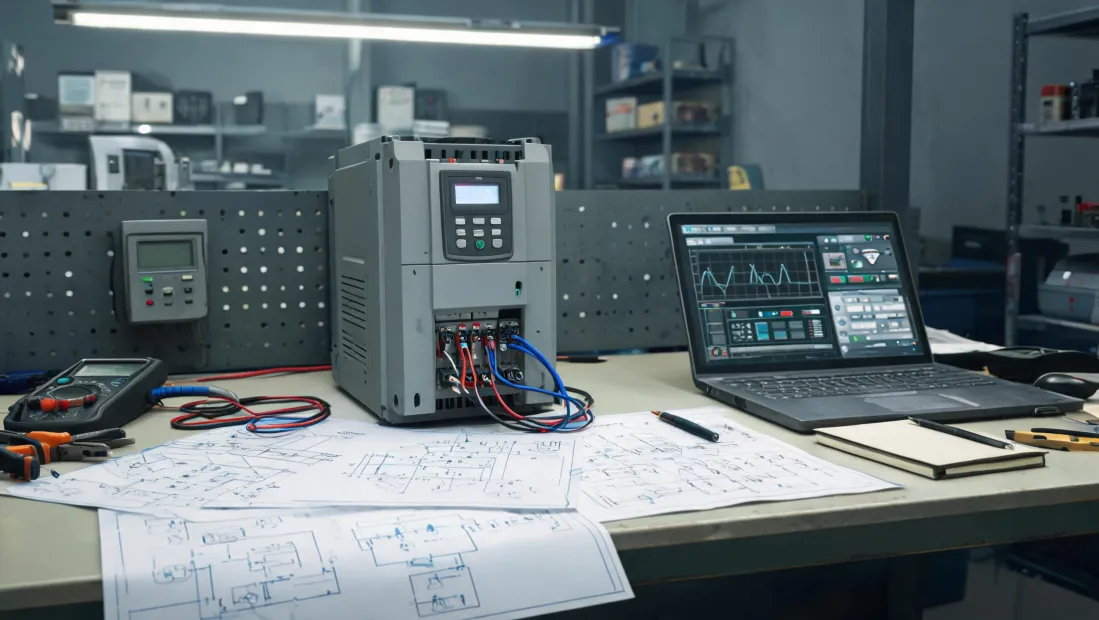
If you're looking for a single "best" Yaskawa VFD, stop. There isn't one. I've been handling procurement for a mid-sized manufacturing plant since 2021, and the question "which Yaskawa VFD should I buy?" only makes sense once you know your situation. Emergency replacement, OEM integration, and plant-wide standardization are three completely different games.
First: Know Which Scenario You're In
Most buying mistakes happen because someone applies the wrong frame. The Yaskawa VFD you need when a machine is down is not the same decision as the yaskawa vfd drives you spec into a product you're building, and neither is the same as a bulk purchase to standardize a facility.
Ask yourself three questions:
- Is something broken right now?
- Am I building equipment that will carry my company's name?
- Am I planning a facility-wide upgrade?
Answer honestly, then read the section that applies to you. If you're in between—and a lot of people are—read Scenario B first. It has the most at stake.
Scenario A: Emergency Replacement
When a drive fails on a production line, the clock is ticking. You need a replacement unit today, not a value analysis. The first instinct is to search the model number and order the cheapest result with the same part number. It's tempting to think a Yaskawa VFD model number is enough. It isn't.
The V1000 series is a good example. A model like CIMR-VZA0004FAA encodes voltage class, enclosure type, and input phase. Change one character, and you might have a 230V unit instead of 460V, or an open-chassis drive instead of a NEMA 4X. My assumption cost us a day of downtime and a restocking fee once, all because the voltage class was one character off. (Note to self: photograph the nameplate before calling anyone.)
What actually matters in an emergency:
- Match the complete model number, down to the last suffix character
- Confirm input voltage, enclosure rating, and current production revision
- Buy from a distributor that stocks genuine Yaskawa VFD inventory, not one that drop-ships from a marketplace
- Verify with an electrician before installation, not after
Here's the uncomfortable part: when a line is down, the drive's price is trivial compared to the cost of idle workers. The "budget alternative" that looks like the same unit and arrives in three days instead of tomorrow—that's not a saving, that's a gamble. If it fails in two months, the maintenance manager won't forget who bought it. (And neither will your finance team, when the warranty claim goes nowhere.)
Scenario B: OEM Integration
If your company builds machinery, the controller OEM decision is more complex. You're not buying one unit to replace a failed component; you're buying the same component over and over to put into a product your customers will judge.
Quality perception is not a fluffy marketing word in this scenario. Your customer opens the control panel and sees what's inside. A genuine Yaskawa VFD, with proper documentation and a recognizable brand, tells them their investment is protected. A no-name drive sourced to save $40 tells them something else entirely. It's not fair, but it's how industrial buyers think.
Few guides talk about firmware consistency. Yaskawa VFD drives with the same part number can ship with different firmware revisions depending on manufacturing date. If you're programming a batch of ten drives identically and one arrives with older firmware, you'll find out during commissioning. The troubleshooting time eats whatever you saved by shopping around.
What to verify before committing to a supplier:
- Firmware consistency across units, confirmed before they ship
- Technical support that can answer application questions rather than reading a script
- Documentation you can pass to your end customer, including wiring and parameter defaults
- UL listing status. Industrial control panels often have to meet UL 508A, and your customer's facility may require listed equipment
One assumption I'd challenge: that all distributors are interchangeable. It's an easy thing to believe until the difference shows up in a late firmware update or a missing declaration of conformity. To be fair, the cheapest option sometimes works fine—I've seen it. But "sometimes" isn't a supply strategy.
Scenario C: Plant-Wide Standardization
The third scenario is where I've seen the most expensive errors, because everyone feels confident. When you're planning a facility-wide upgrade, the conversation shouldn't start with "which drive?" It should start with "what system?"
Standardizing on yaskawa vfd drives across a plant gives you spare-parts commonality, one programming platform, a single vendor relationship, and one training path for your maintenance team. Those are real advantages. But the supporting components can undo everything. If you're adding a bulk safety PLC purchase to a retrofit, the drives, contactors, and safety controllers all have to work as a system.
Consider the contactor specification guide, for example. A common misconception is that any contactor with the same current rating will work. In practice, the contactor should be sized based on the motor's full-load current, not the drive's output rating, and the utilization category (AC-3 for motor switching vs. AC-1 for resistive loads) determines its real-world capability. Miss that detail, and you'll get a contactor that runs hot, welds closed, or fails an inspection under NFPA 79 wiring requirements. (Which, honestly, sounds like the kind of thing you can ignore until you're explaining to a plant manager why the panel has a red tag on it.)
For bulk purchases, the short list:
- Confirm the distributor is an authorized Yaskawa channel partner. Gray-market goods mess with warranty enforcement.
- Get firmware and manufacturing date commitments in writing
- Run a small pilot before committing to the full quantity
- Verify your own team's readiness; one platform beats three
The counterintuitive advice: in a bulk scenario, paying a modest premium for genuine product, a responsive distributor, and coherent documentation is usually the cheaper decision over a three-year horizon. I say "usually" because I've seen the budget approach work when the application was simple and the team was experienced. That's the exception. Plan for the rule.
How to Decide Which Scenario You're In
Still not sure? Use the deadline test.
If this purchase has a deadline measured in days because machinery is stopped—Scenario A. Optimize for speed and exactness before price.
If this purchase is going into a product your company sells—Scenario B. Optimize for consistency, support, and documentation. Your brand is in the box.
If this purchase is part of a budgeted project with a timeline in months—Scenario C. Optimize for system coherence and long-term support.
If you're in more than one scenario—say, building a panel that includes a drive and safety components—the strictest requirements win. Don't apply emergency logic to a long-term investment, and don't apply system-level thinking to a critical failure.
The Common Lesson
The recurring lesson after five years of managing these purchases: quality is not the extra cost. The genuine Yaskawa VFD, with the correct firmware, from a distributor who answers the phone, backed by documentation you can file—that's the baseline. Anything below that baseline saves money once and costs trust repeatedly.
I still kick myself over a vendor who couldn't provide proper invoicing back in 2022. Finance rejected $2,400 worth of expense claims because the supplier produced handwritten receipts. The department budget ate it. That wasn't a VFD problem—it was a procurement quality problem—but the principle carried over: verify before you commit. Quality is the cheapest insurance you'll buy.
To be clear, I'm not saying buy the most expensive option every time. I'm saying buy the option you've verified: the right model, the right source, the right documentation. For Yaskawa VFD drives, that's not a luxury. It's the cost of doing business without embarrassing surprises.